
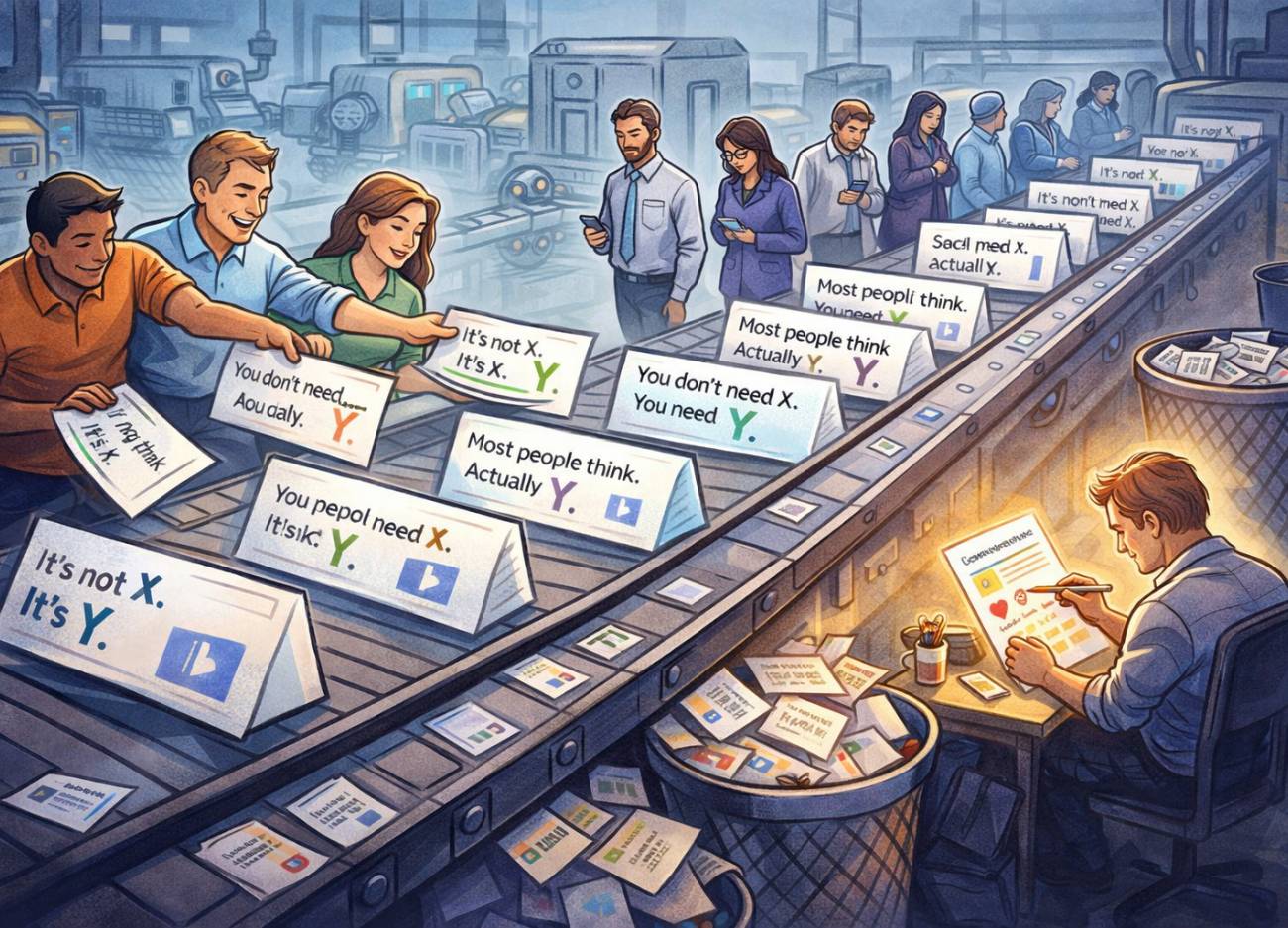
AI LinkedIn posts have exploded over the last year.
And along with that explosion came something else: repetition.
If you have been on LinkedIn recently, you must have noticed that many LinkedIn post templates and LinkedIn writing formats now look strangely similar. This is exactly why LinkedIn posts sound the same today.
A very specific format is being repeated again and again in AI LinkedIn content – false contrast hooks, and now the human brain is starting to filter it out.
AI LinkedIn Posts and the Most Repeated Pattern
In the last 60 minutes, we came across three posts on LinkedIn. Different people. Different industries. Same structure.


Do you see the pattern in these lines?
- Most startups don’t fail because of bad ideas.
- Most startups don’t fail because of bad ideas.
- Startups don’t fail on ideas.
It’s the “Not this… This.” format.
Go to LinkedIn Now. You’ll See This Everywhere
- “You don’t need more motivation. You need better systems.”
- “Personal branding is not about posting. It’s about positioning.”
- “Marketing is not about reach. It’s about trust.”
- “Your CV is not what gets you hired. Your reputation does.”
- “Networking is not about meeting people. It’s about being remembered.”
- “Productivity is not about time management. It’s about attention management.”
God!!!
This is one of the most common LinkedIn post templates used in LinkedIn thought leadership posts and AI LinkedIn content today.
It is Linkedin’s most hardworking hook.
This Pattern Has a Name: The False Contrast Hook
This format is called a False Contrast Hook.
| Format | Example |
|---|---|
| It’s not X. It’s Y. | It’s not experience. It’s exposure. |
| You think X. Actually Y. | You think networking is about people. It’s about access. |
| Most people focus on X. The real problem is Y. | Most founders focus on funding. The real problem is distribution. |
Before AI, it worked, it spread. And because it spread, AI learned it. And because AI learned it, now everyone is using it.
This is why many social media writing formats, engagement hooks, and pattern-based writing frameworks use this structure. It is very easy for AI content writing tools to generate.
You Need to Stop Using This
Do you know about banner blindness?
It is essentially when people see the same layout again and again, their brain stops processing it.
The same thing is now happening to LinkedIn hooks.
When every post starts with the same contrast pattern, the brain recognises the structure and moves on. Like background noise. Like elevator music. Like ads on a website you never notice even though they are right in front of you.
If you want people to actually read, and engage with your posts, you need to stop using false contrast hooks.
When a format becomes popular, it works.
When a format becomes common, it becomes invisible.
That’s the lifecycle of every viral LinkedIn post format ever created.
If You Only Use AI For LinkedIn Posts, Personal Branding Will Not Take Off
| Before | Now |
|---|---|
| Unique writing styles | Same hooks |
| Original insights | Same frameworks |
| Real stories | Template stories |
| Personal voice | AI voice |
This is where personal branding on LinkedIn starts to weaken.
Personal branding is as much about posting frequently, as it is about being remembered.
Do you really think you will be remembered if you were like everyone else?
AI made content faster. It also made content look the same. Like fast food.
And when everything looks the same, nothing stands out.
So Should You Stop Using AI To Write LinkedIn Posts?
Nope.
ChatGPT, Claude, Gemini, Perplexity, Grok and the hundreds of other tools that will show up are absolutely worth using. Anyone still debating whether to use AI is already behind. That ship has sailed.
What matters is how you use it.
AI is a tool for speed.
It is not a substitute for perspective. It is not a substitute for experience. It is not a substitute for having something real to say in the first place.
The Right Way To Use AI To Write LinkedIn Posts
Right now, most professionals open AI tools and type a topic, and the tool produces a finished LinkedIn post. The structure, hook, and flow are already decided by the system because it has learned from high-performing posts. That is why so many AI LinkedIn posts end up using the same hooks, the same rhythm, and the same “Not this… This.” structure.
If you want AI to actually help your LinkedIn positioning, use it like this:
Step 1 — Start With a Real Situation
Open a document and write down one of these:
- A conversation you had with a client
- A mistake you made in business
- A hiring decision
- A deal that almost worked but didn’t
- A pattern you are noticing in your industry
- A question clients keep asking you
- Something in your industry that you strongly disagree with
Step 2 — Give AI Context
Now give AI a proper brief. For example:
I run a company that helps founders with LinkedIn positioning.
My audience is founders and senior professionals.
I want to be known for clear thinking and strong opinions.
Here are my rough notes:
[paste your rough notes]
Turn this into a LinkedIn post. Keep the tone direct and experience-based. Avoid common LinkedIn hooks and list formats.
Step 3 — Force Originality
Add this line in your prompt:
Do not use these formats:
- “It’s not X. It’s Y.”
- “Most people think…”
- “Here are 3 lessons…”
- “Unpopular opinion…”
- “Nobody talks about this…”
Step 4 — Improve the Post
Once AI gives you a draft, don’t post it immediately. Ask AI:
Make this sharper.
Make this more conversational.
Shorten the sentences.
Make the opening stronger.
Give me 3 alternative opening lines.
Give me 3 alternative closing lines.
Now you are using AI like an editor, not like a ghostwriter.
What If AI Still Gives Contrast Hooks
AI, especially ChatGPT, really lurvvvs contrast hooks.
Even when you clearly tell it not to use that structure, it keeps brings it back.
You: Don’t use the “Not this… This” format.
GPT: Understood. I will avoid that structure.
AI (next draft): “Success is not about working harder. It’s about working smarter.”
GPT: You just did it again.
GPT: You’re right. Thank you for pointing that out. I will avoid it.
GPT (next draft): Uses it again.
At some point you just sit there and stare at the screen.
So here’s what to do:
Try different models
- ChatGPT
- Claude
- Gemini
- Perplexity
Different models follow instructions differently. From what we have seen in real client work, Claude is usually better at following tone and structure instructions over multiple edits.
But after all of this, one thing becomes very clear very quickly.
Manual editing wins. Every time.
You have to read the post line by line before publishing.
If a line feels predictable, rewrite it. If a line sounds like something you would actually say out loud, keep it.
Give your thought leadership and your stories the same amount of time you expect your followers to give your posts.
FAQs
Why do all LinkedIn posts sound the same now?
Many LinkedIn posts sound the same because people use the same LinkedIn post templates and AI content frameworks. These frameworks rely on repeatable hook structures like contrast hooks, which makes content feel repetitive over time.
Are AI LinkedIn posts hurting personal branding?
AI LinkedIn posts can hurt personal branding if they make your content sound like everyone else. Personal branding on LinkedIn depends on distinct thinking and voice, not just consistent posting.
What is the best LinkedIn post format for engagement?
The best LinkedIn post format for engagement combines a strong hook, a clear insight, and a personal perspective. Formats help structure content, but original thinking is what drives engagement.
Why do LinkedIn thought leadership posts use the same format?
LinkedIn thought leadership posts use similar formats because certain content frameworks have historically performed well. AI LinkedIn content tools reproduce these formats because they are trained on high-performing posts.
How do I write LinkedIn posts with AI without sounding generic?
To write LinkedIn posts with AI without sounding generic, use AI to structure and edit your ideas, but base the content on your own experiences, opinions, and industry insights.
Is LinkedIn content becoming repetitive because of AI LinkedIn posts?
LinkedIn content is becoming repetitive because AI LinkedIn posts make it easy to reproduce the same writing formats and engagement hooks at scale. When too many people use the same templates, the content starts to feel identical.
TL;DR
- Everyone on LinkedIn is using the same “Not this… This” post format.
- This format is called “False Contrast Hook”.
- It worked earlier. Then it spread. Then AI learned it. Now everyone sounds the same.
- When the brain sees the same format again and again, it starts skipping it.
- So yes, use AI. But don’t let AI decide your structure, your ideas, or your voice.
- And before you publish, read the post like a human being.